
Ceiling Fan Installation in the USA
All Tech Electric technicians trace the branch circuit from the ceiling box back to the service panel, confirming that 14 AWG or 12 AWG conductors match the motor nameplate amperage and that the breaker does not exceed 80 percent continuous load. They measure voltage drop under simulated startup torque to ensure the fan will not dim lights or trip adjacent devices sharing the circuit.
Next the junction box is examined for its listed support rating, typically 35 or 50 pounds, and for secure attachment to a joist or brace rather than drywall alone. Grounding continuity is verified with a low-impedance tester while the neutral is isolated to prevent borrowed grounds that could energize the fan chassis during operation. Neutral conductor integrity matters in ceiling fan installation so All Tech Electric lists procedures on the homepage across the USA.
Warning Signs During Ceiling Fan Use
- Breaker trips immediately when fan speed is increased.
- Wobble increases with each successive blade rotation.
- Light fixture dims when motor reaches operating speed.
- Humming sound continues after switch is turned off.
- Ceiling box moves slightly when blades are turned by hand.
Circuit and Box Assessment
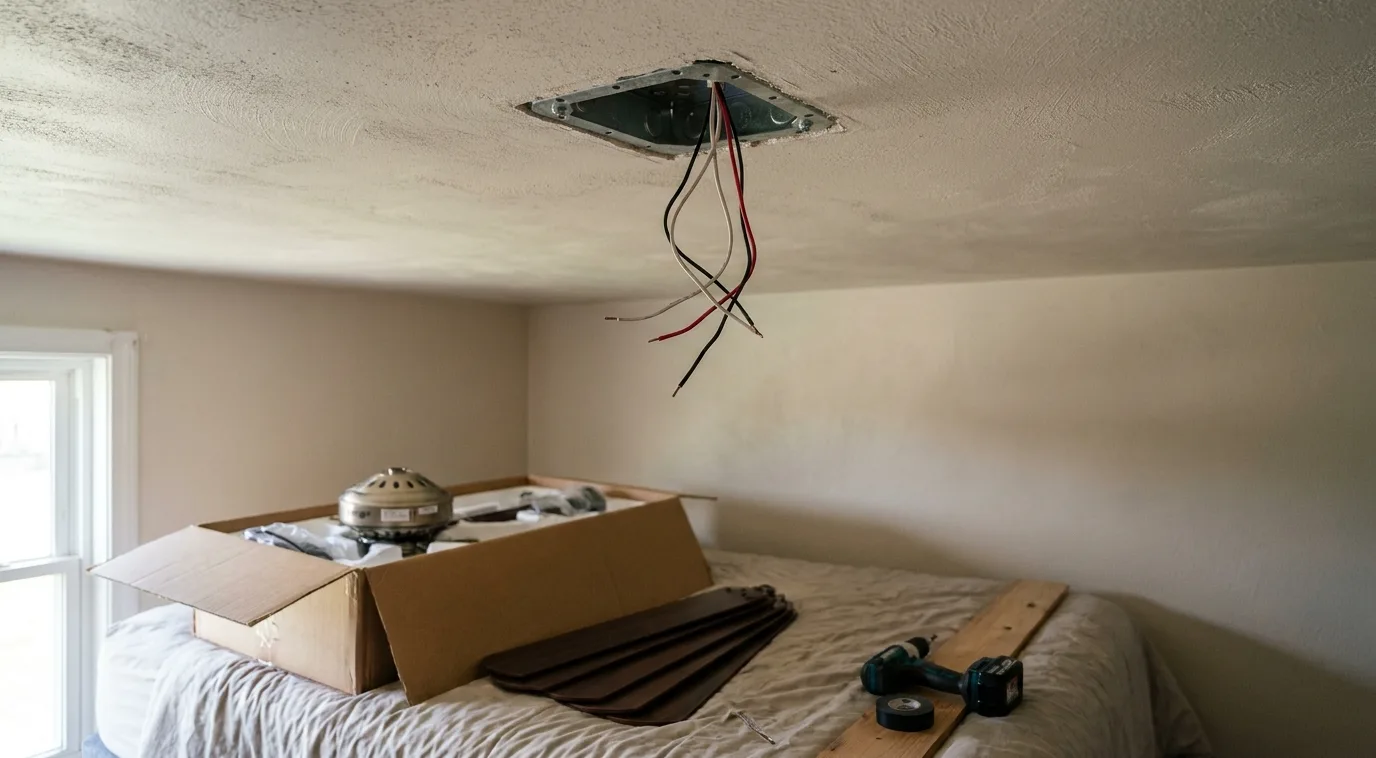
Technicians first de-energize the circuit at the breaker and lock it out. They remove the existing fixture to inspect the box for fan-rated markings and measure the distance between mounting holes to match the fan canopy. Any box lacking a brace is replaced with a rated fan brace that spans the joists before any wiring proceeds.
The existing switch loop is tested for proper traveler identification so the fan can be controlled independently from any light kit. Neutral presence at the box is confirmed because many modern fans require it for the receiver module. If the circuit serves other outlets, the combined load is calculated to avoid nuisance trips once the fan motor is added.
Mounting Hardware and Balance
A downrod of the correct length is selected so blades clear the floor by at least seven feet. The ball-and-socket hanger is seated fully and the safety cable is looped through the box brace. Blade brackets are torqued in a star pattern, then each blade is weighed to detect manufacturing differences that cause vibration.
After power is restored, the fan is run through all speeds while a non-contact tachometer records RPM. Any visible wobble is corrected by adding or removing balancing clips on the leading edge of the lightest blade until the assembly spins true within 0.5 millimeters at the tip.
Wiring and Control Options
Pull-chain, wall-switch, and remote-receiver configurations are offered. When a receiver is installed, the antenna is positioned away from metal ductwork and the line and load sides are kept separate to avoid RF interference with the motor capacitor. All splices are made with twist-on connectors rated for the wire size and then folded neatly into the canopy without pinching insulation.
If the fan includes an integrated light kit, the additional wattage is added to the circuit load calculation. A separate neutral is always landed at the light socket so that smart-home dimmers can be installed later without rewiring the box.
Homeowner Preparation Steps
Before the arrival of All Tech Electric technicians, the homeowner should locate the breaker that feeds the ceiling box and verify it controls the circuit by testing an outlet with a lamp. Any stored items in the attic directly above the fan location should be moved aside so the brace installation can proceed without obstruction.
The existing fixture should be removed only if the homeowner is comfortable working at ladder height; otherwise the canopy can stay in place until the technician arrives. Note the make and model of the desired replacement fan so the correct downrod length and blade sweep can be confirmed in advance.
Ceiling Fan Installation questions
What box rating is required for a standard ceiling fan?
The box must be listed for fan support, typically 35 pounds minimum, and attached to framing with a brace rated for the combined weight of the fan and any light kit. Standard fixture boxes attached only to drywall are insufficient and must be replaced.
Does a ceiling fan need a neutral wire?
Most fans with remote receivers or smart controls require a neutral at the box. If only two wires are present, a new neutral may be pulled or the receiver may be relocated to a different location where neutral is available.
How is fan wobble corrected after installation?
Each blade is weighed and balancing clips are added to the lightest blades. The downrod is checked for plumb and the hanger bracket is tightened. Motor mounts are inspected for looseness before any further adjustments.
Can an existing light switch control both fan and light?
A three-way or single-pole switch can be rewired with a separate traveler for the fan motor and light kit. When a receiver is used, the wall switch becomes a constant hot and the remote handles separate control of each function.
Ceiling Fan Installation Details
All Tech Electric technicians verify box ratings and circuit capacity before completing Ceiling Fan Installation across the USA.