
Electrical Troubleshooting in the USA
All Tech Electric handles Electrical Troubleshooting by starting at the service panel and working outward through branch circuits. Technicians first confirm main breaker capacity and neutral-ground bonding, then measure line-to-neutral and line-to-ground voltages under load. This sequence reveals whether an issue stems from supply, distribution, or individual outlets and fixtures.
Next the team isolates each circuit with a clamp meter to record actual amperage against wire and breaker ratings. They check for voltage drop on long runs, test GFCI and AFCI devices for proper trip thresholds, and inspect connections for heat discoloration or looseness. These steps pinpoint the exact location of high resistance or overload without unnecessary demolition. We check grounding continuity during electrical troubleshooting before directing visitors to the All Tech Electric homepage in the USA.
Warning Signs That Require Electrical Troubleshooting
- Lights dim or flicker when large appliances start.
- Breakers trip repeatedly on one specific circuit.
- Outlets feel warm or show burn marks around the plate.
- A persistent burning odor comes from the panel or walls.
- Certain rooms lose power while others remain energized.
Typical Causes Found During Electrical Troubleshooting
Overloaded branch circuits occur when added loads exceed the 15- or 20-amp breaker rating, causing heat at terminations and eventual trip. Technicians calculate connected wattage and compare it to conductor ampacity to confirm this condition.
Loose neutral connections in the panel or at splices create intermittent voltage swings that damage electronics. Measurement of floating voltage on the neutral conductor under load confirms the fault location.
Ground faults develop when insulation breaks down and current leaks to the equipment grounding conductor. A megger test between conductors and ground isolates the affected cable run.
Measurements and Inspections Performed by Technicians
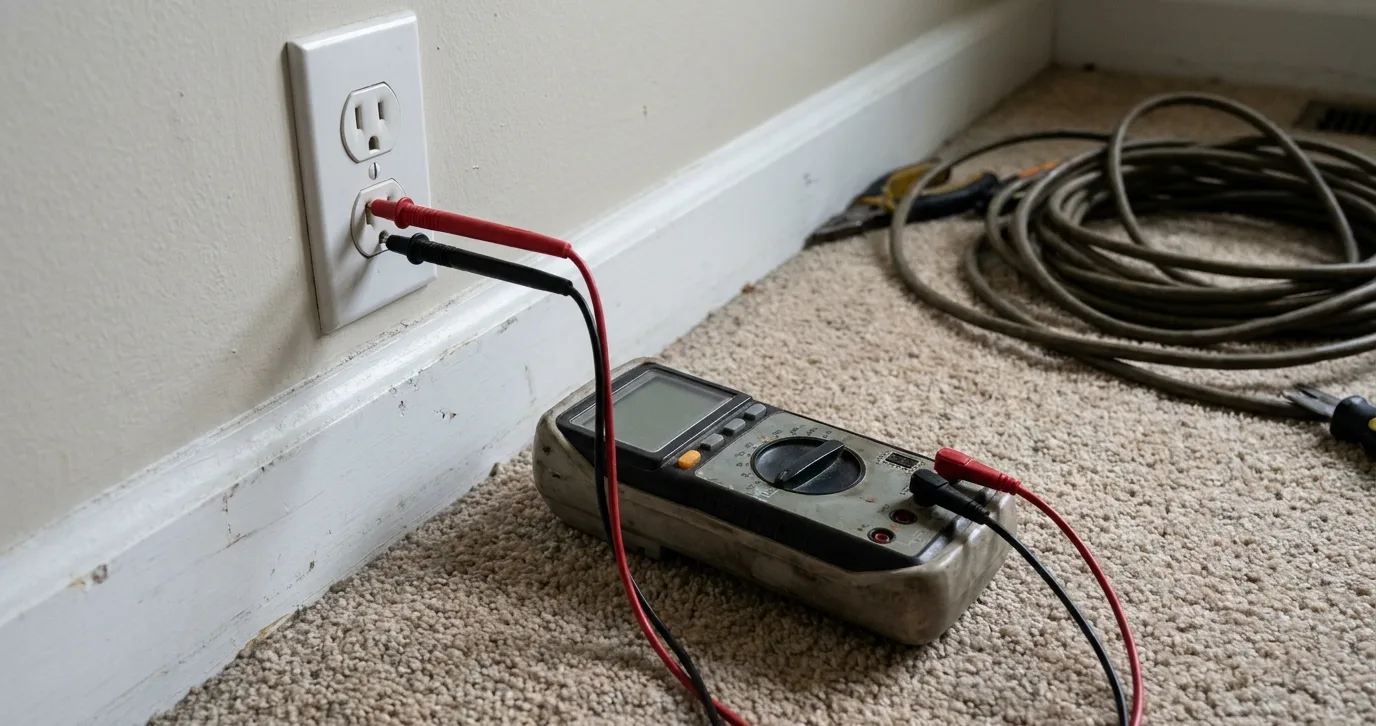
Technicians begin with a non-contact voltage tester at the panel, then use a digital multimeter to record 120-volt and 240-volt readings at each breaker lug. They next verify continuity of the equipment grounding conductor back to the main bonding jumper.
Infrared thermography identifies hot spots at breaker stabs, wire nuts, and outlet terminals without removing covers. Load current is logged on suspect circuits for fifteen minutes to capture peak draw.
Receptacle polarity and ground integrity are checked with a plug-in tester, followed by manual torque verification of terminal screws. Any reading outside tolerance triggers further tracing with a tone generator.
Repair and Replacement Options During Electrical Troubleshooting
When a breaker shows signs of internal wear, replacement with an identical amperage and type restores protection. If the fault lies in a damaged cable, the run is replaced from the nearest accessible junction to the device.
Loose neutral bars receive new lugs or full bar replacement. High-resistance splices are redone with fresh wire nuts or insulated mechanical connectors rated for the conductor size.
Where aluminum branch wiring is present, technicians install CO/ALR receptacles or pigtail copper tails with approved connectors to eliminate expansion-related loosening.
Actions Homeowners Can Take Before All Tech Electric Arrives
Locate the main panel and note which breakers correspond to the affected areas. Switch off breakers for any circuit showing repeated trips or warm outlets to prevent further heating.
Unplug all loads on the troubled circuit and visually inspect cords and plugs for damage. Avoid resetting a tripped breaker more than once until the cause is identified.
Prepare a list of recent changes such as new appliances or renovations that coincided with the onset of symptoms. This information helps technicians narrow the diagnostic path quickly.
Electrical Troubleshooting questions
What does Electrical Troubleshooting include?
All Tech Electric begins at the service entrance, measures voltages and currents on each circuit, verifies grounding continuity, and isolates faults in wiring, breakers, or devices. The process ends with a written summary of findings and recommended repairs.
How long does Electrical Troubleshooting take?
Duration depends on the number of circuits and accessibility of wiring. A single-circuit issue may require under an hour of testing, while whole-home symptoms involving multiple panels and subfeeds can extend through several hours of systematic measurement.
Can homeowners safely reset breakers during Electrical Troubleshooting?
Resetting a breaker once is acceptable if the cause is known, such as a temporary overload. Repeated trips indicate a persistent fault; homeowners should leave the breaker off and avoid further resets to prevent damage or fire risk.
What parts are commonly replaced after Electrical Troubleshooting?
Technicians often replace breakers that no longer hold calibration, damaged receptacles with melted contacts, and sections of cable showing insulation failure. New mechanical connectors or pigtails address loose terminations at the panel.
Schedule Electrical Troubleshooting
Contact All Tech Electric to begin systematic diagnosis of circuit faults, voltage issues, and grounding problems across the USA.